How to Seal Watercolor Inn Art Journal With Other Media
 This article is part of my Gratuitous eastward-course Art Journaling 101 – which has been designed to gently introduce beginners to the basics of art journaling so you tin can find your way with more than ease and less fearfulness. If you're curious nearly art journaling or overwhelmed with how to brainstorm, sign up for the full costless class HERE.

With so many choices, its easy for one to go overwhelmed when trying to cull what type of volume to utilise for their new art journal. You lot plainly want to choose something that you'll be inspired by, but there are many other things to recall nigh likewise looks. Such as:
Blazon of Newspaper – Think about what types of mediums yous'll exist using in your art journal. If you know you want to play with watercolors a lot, perhaps y'all should choose a book with watercolor paper. If you're going to be using more often than not dry media like colored pencils, crayons, pens, and markers and then thinner paper volition work only fine. If y'all'll exist using a variety of mediums like acrylic, watercolor, markers, and more, and so you lot may want to become with a mixed media paper, watercolor newspaper, or something thick similar cardstock to be able to withstand all of the h2o and layers.
Simply that's non to say that you lot tin can't use whatever you take laying around, or that gorgeous notebook you constitute just because it doesn't have the correct paper.
At that place are means around that. Which brings united states of america to the second thing to consider…
Time vs Money – When it comes down to information technology, you have to decide which is more important to you, saving money or saving fourth dimension.
Usually, blank journals with thicker pages are more expensive; only you'll be able to swoop right in with your journaling with piddling to no prep. Your other culling would be to use a cheaper volume and "beef upwards" the pages to be able to handle your creative play.
If the pages are too thin for your mediums, you'll demand to "mucilage" two or more than pages together with gel medium or a glue stick in order to make them thick enough to support your layering and paint. So, if you don't like your pages getting wrinkly, you might want to put a glaze of gesso on each page to ready it to take your paints. This prep work tin can become very time consuming, merely tin be worth it if y'all're tight on cash or can't find the perfect periodical.
Stability – There's nix worse than putting all of your centre, time, and energy into an art journal only to find it falling to pieces when yous're finished. If you're considering a blank book not specifically made for art, or peradventure an old volume to recycle, you'll want to look carefully at the spine.
Some books are held together with glue, which will only pb to disaster after connected handling, and afterwards applying moisture mediums and additional weight with layers. You want to brand certain the book is bound by stitching (or use a spiral notebook).
To cheque if your book was leap by stitching, endeavor finding the center folio. Each "signature" or department of pages volition be stitched to the spine, so yous'll be able to run into the stitching when you lot open upward a signature. You may find it difficult to notice the eye of a signature in some larger difficult cover books; in that case, try looking closely at the pages where they encounter the spine. If they're stitched together, you'll notice that the paper has been folded in half to create two pages.
Size – If you lot're just starting out, a smaller journal may exist less intimidating. Merely larger journals provide more space for journaling and play. If you're unsure, a adept size to start with is around 6×9″. It's only big enough to paint, doodle, and journal; only small enough as to not scare you off!
Here are some popular choices to consider:
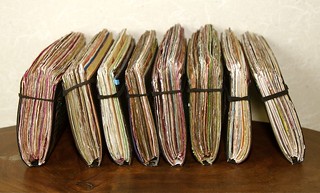
Moleskines by Barry via Flickr
Moleskine (or similar bound journal) – Moleskines seem to be the #1 choice for most sketch book artists and many art journalers. Their quality is supurb and they come in many unlike paper types (non to mention, they expect so awesome when all filled upwards!). If you plan to employ moisture mediums in a moleskine I would recommend going with the sketch book or watercolor volume; their other varieties have pages that are much too sparse.
Pros: durable, rigid cover, elastic closure
Cons: the newspaper is a bit thin for wet mediums so they should be gessoed start, not much room for thick embellishments, somewhat pricey

Spiral Bound Journals – At that place are a wide variety of spiral spring notebooks which are great for art journaling. You can find ones with any type of newspaper yous demand such as the all-media book I have pictured here. Creative person Robin-Marie Smith shares how she disassembles her Canson journal to work on the pages separately in this video HERE.
Pros: pages e'er lay flat, you can remove the pages to piece of work in them seperately then leap them back together again, comes in a broad diverseness of paper types
Cons: wire can get defenseless on things, pages tear out more easily, tin't really do a two page spread

Handmade Journals – Handmade journals are always a great choice because you can be rest assured that the bounden has been stitched for a sturdy book, and they're usually fabricated with sturdy paper. They are also the most bonny books to utilize (in my stance) since they are handmade by artists. Yous can usually detect handmade books in specialty shops or online. Or, acquire how to make your ain to customize it to your needs!
Pros: strong stitched binding, comes in a wide variety of styles, ordinarily comes with thick paper (merely be certain to e'er bank check!)
Cons: can exist hard to observe locally, can sometimes be pricey due to the time information technology takes to make by hand and costs of materials, can be time consuming to make your own
Limerick Notebooks – Composition books tin can be found just about anywhere (particularly at the kickoff of the school flavor!) and are super cheap. The only problem is that the pages are pretty thin, then you need to practice a lot of prep work if you want to paint in it. But I take found these lined notebooks to be my most favorite tool for art journaling! The prep work turned out to be quite enjoyable for me. Plus, I find them to be less intimidating than other journals, and allows me to get loose and non care well-nigh what the final result looks like.
Pros: super cheap and tin be establish in almost any shop, stitched binding
Cons: pages are super thin, needs lots of prep work

Quondam Hardcover Books – Y'all can pick upwards former hard embrace books for cheap at a thrift shop or rummage auction. They are great to use for fine art journaling because they are ordinarily durable and they provide interesting pages to brainstorm with. There is a ton of info online on how to employ a hardcover book for journaling, simply I accept establish this article and this video to be pretty helpful.
Pros: can be found super cheap, durable (as long equally its a stitched binding), eco-friendly since you lot're not purchasing a new item
Cons: lots of prep work, you must remove many pages on guild to make room for the thickness of your art
What's your favorite art journal? I'd love to hear your thoughts. :)

Don't miss a unmarried, inspiring thing!
Subscribe to my Museletter for inspiration and applied tips to keeping on runway with this scary journey of reclaiming yourself and your creativity. You lot'll also get VIP admission to my new goodies, freebies, special offers, and more!
P.S. We value your privacy and will protect information technology. Read our Privacy Policy for all the details.
Success! Now check your email to confirm your subscription.
bothwellocceslight.blogspot.com
Source: https://kristalnorton.com/art-journaling-101-choosing-your-journal/
0 Response to "How to Seal Watercolor Inn Art Journal With Other Media"
Postar um comentário